How to Calculate Your Grade With Weighted Categories
Work out your class grade from weighted categories like homework 20% and exams 40%: the formula, a worked example, and why your gradebook may differ.
Your transcript may show two GPAs. Here's how each one is calculated, why they differ from school to school, and which number goes on your college applications.

Many high school transcripts show two GPAs. The unweighted one treats every class the same; the weighted one gives extra points for harder classes such as Honors, AP and IB. Both are "your GPA", which is why it's easy to get confused about which number to use, especially when an application asks for it. Here's how each one is calculated, why the numbers differ from school to school, and what to report.
An unweighted GPA uses one scale for every class, usually from 0 to 4.0. A common version gives 4.0 for an A, 3.0 for a B, 2.0 for a C and 1.0 for a D, with pluses and minuses in between: an A- is 3.7 and a B+ is 3.3. Add up the points for each class, multiply by the credits if your classes carry different credit values, and divide by the total. An A in PE and an A in AP Calculus are both worth 4.0.
A weighted GPA adds a bonus for advanced classes. Many schools add 0.5 for an Honors class and 1.0 for an AP or IB class, so an A in AP counts as 5.0 instead of 4.0. That's how Pocklit's calculator works too (with 0.5 for Dual Enrollment college classes), but policies differ, so check your school's handbook or ask your counselor.
One result surprises people: in a weighted GPA, a B in an AP class (3.0 + 1.0 = 4.0) counts the same as an A in a regular class.
Here's one semester with five classes, each worth one credit. Each GPA is the column's total divided by five: 18.0 ÷ 5 = 3.60 unweighted, and 20.5 ÷ 5 = 4.10 weighted.
| Class (grade) | Unweighted | Weighted |
|---|---|---|
| AP Biology (A) | 4.0 | 5.0 |
| Honors English (B+) | 3.3 | 3.8 |
| AP Calculus (B) | 3.0 | 4.0 |
| Spanish III (A-) | 3.7 | 3.7 |
| US History (A) | 4.0 | 4.0 |
| GPA | 3.60 | 4.10 |
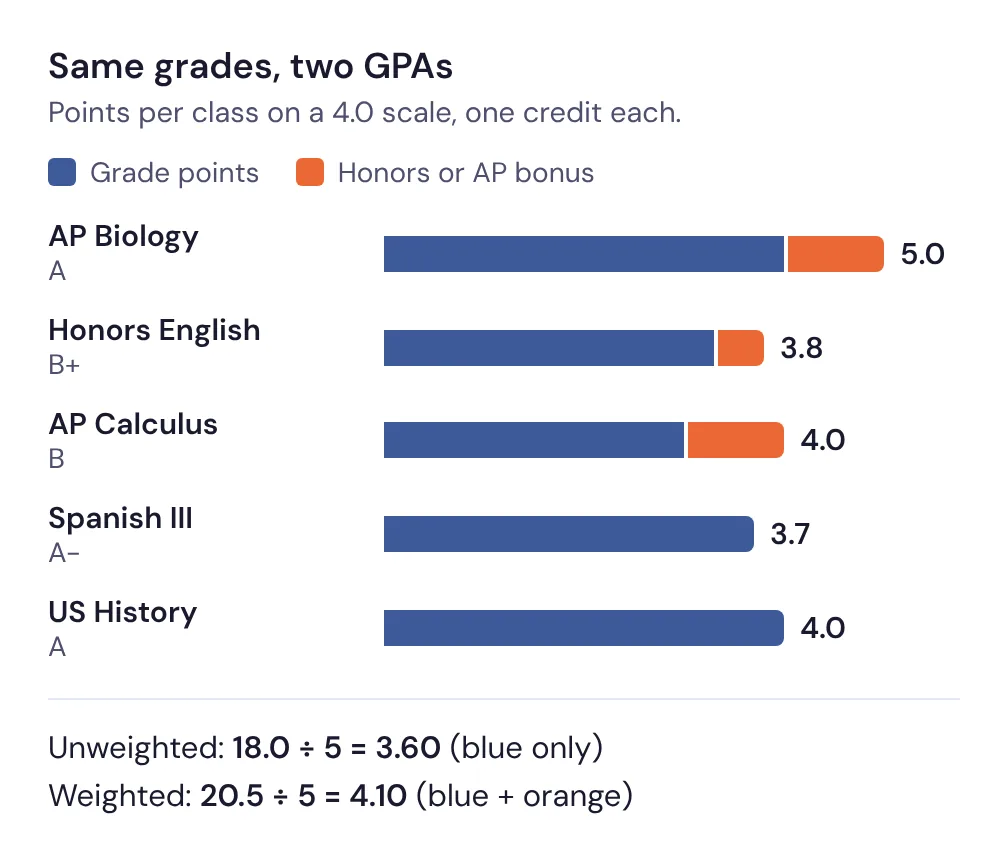
The grades are identical in both columns. The half point between the two GPAs comes entirely from course choice: two AP classes and one Honors class add 1.0 + 1.0 + 0.5 = 2.5 points, spread across five classes.
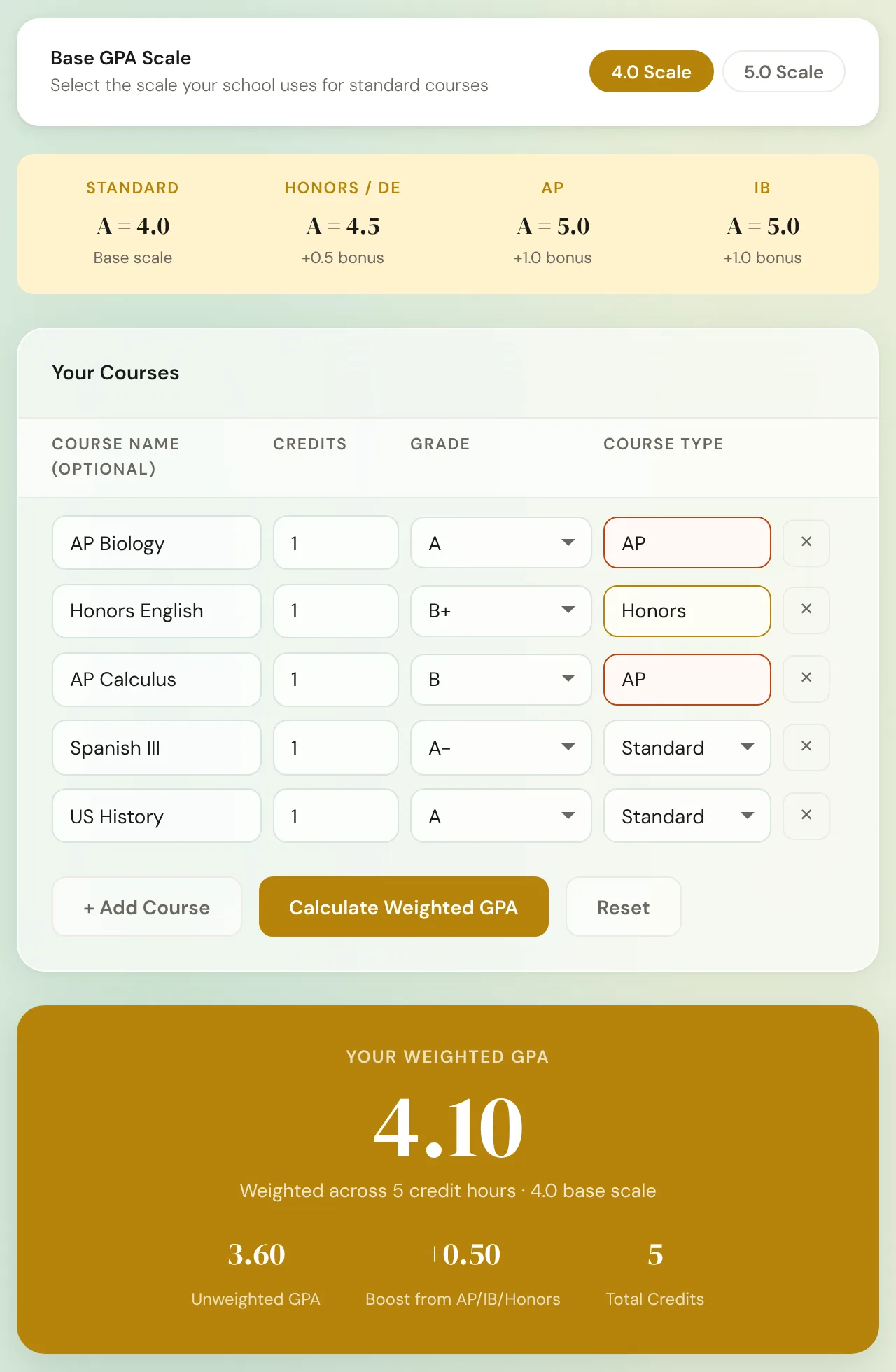
The calculator runs in your browser and doesn't save anything you enter.
The University of California shows how different a college's own GPA can be. It uses only A–G college-prep classes from the summer after 9th grade through the summer after 11th, ignores pluses and minuses, and for California residents adds one extra point per semester of an approved honors-level class, up to 8 points in total and no more than 4 in 10th grade (UC Admissions).
Whichever GPA you report, colleges also see your transcript, which lists every class and grade, so they can tell an A in AP Biology from an A in a regular class. Some, like the University of California, then recalculate a GPA with their own rules so applicants from different schools can be compared on the same terms.
So neither number is "better". The unweighted GPA shows how well you did; the weighted GPA also reflects how hard your classes were. Behind both, the record that counts is the classes you took and how you did in them.
Grades inside a single class, like homework 20% and exams 40%, are a different calculation. For that, see our guide to calculating your grade with weighted categories.
An unweighted GPA scores every class on the same scale, usually up to 4.0. A weighted GPA adds bonus points for harder classes, often 0.5 for Honors and 1.0 for AP or IB, so it can go above 4.0.
Report the GPA your school calculates. If your school calculates both, Common App's guidance for counselors says students should report the weighted value.
Some do. The University of California, for example, uses only A–G classes from the summer after 9th grade through the summer after 11th, ignores pluses and minuses, and limits the extra honors points.
In a weighted GPA with a 1.0 AP bonus on a 4.0 scale, they count the same: 4.0 each. Your unweighted GPA, and the transcript colleges see, still show the B.

Work out your class grade from weighted categories like homework 20% and exams 40%: the formula, a worked example, and why your gradebook may differ.

Work out the exact score you need on your final exam to reach an A, B or C, with the formula, worked examples and what to do if you need over 100%.