
What Do I Need on My Final? Formula and Examples
Work out the exact score you need on your final exam to reach an A, B or C, with the formula, worked examples and what to do if you need over 100%.
If your syllabus says homework is 20% and exams are 40%, your grade isn't a simple average. Here's the formula, a worked example, and a quick way to check it.

Many syllabi split your grade into categories with weights: homework 20%, quizzes 15%, a midterm 25%, a final exam 40%. That means a 95 on one homework assignment and a 95 on the midterm don't count the same, and averaging all of your scores together gives the wrong answer. The weights decide how much each category moves your grade. Here's how to work it out by hand, and how to check it in a few seconds.
Multiply each category's average score by its weight, add the results, and divide by the total weight of the categories that have grades so far:
Grade = (score × weight + score × weight + …) ÷ (sum of the weights)
Use each category's average, not individual assignments. If your homework scores are 90, 95 and 91, the homework average is 92. That number goes into the formula once, with the homework weight.
Dividing by the weights counted so far is what makes the formula work in the middle of a term. If only 60% of the course has been graded, your grade so far is the weighted average over that 60%, not over the full 100%.
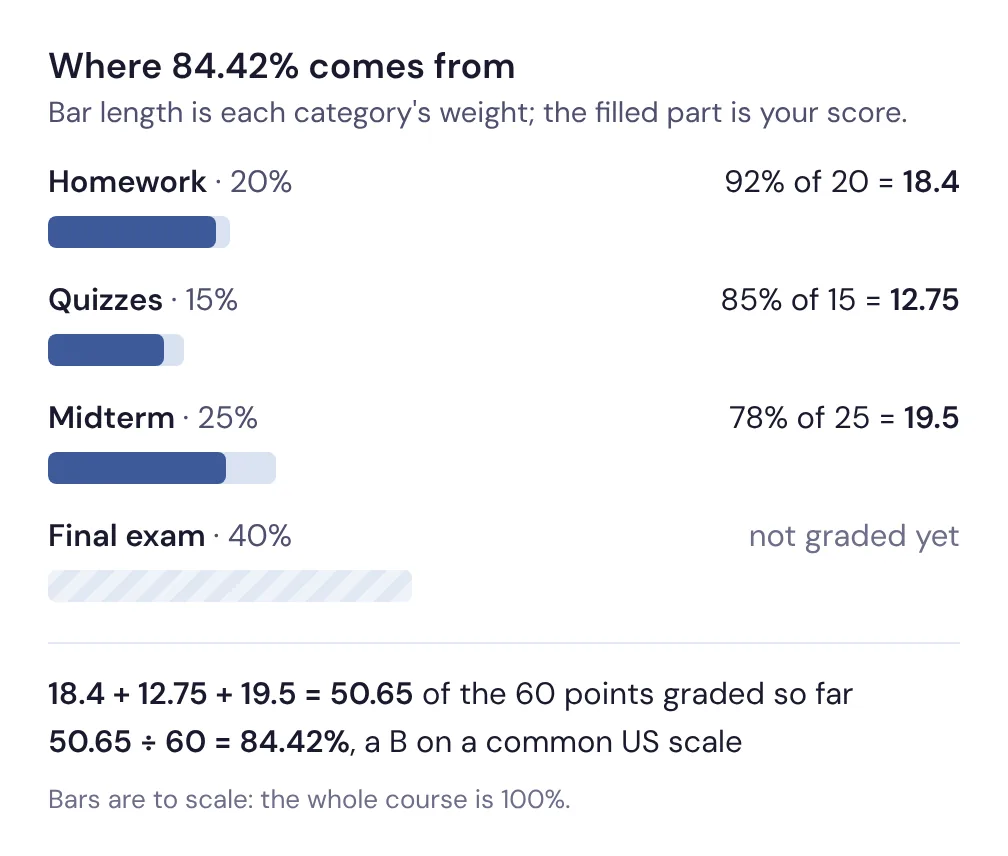
The syllabus says homework 20%, quizzes 15%, midterm 25% and final exam 40%. The final hasn't happened yet. Your averages are 92% in homework, 85% in quizzes and 78% on the midterm.
Add them: 1,840 + 1,275 + 1,950 = 5,065. Then divide by the weight graded so far, 20 + 15 + 25 = 60: 5,065 ÷ 60 = 84.42%. On a common US scale, where an A starts at 93% and a B at 83%, that's a B.
Another way to see the same thing: homework is worth 20 points of the course, and you've earned 92% of them, which is 18.4 points. Do that for each category and you have 50.65 of the 60 points graded so far.
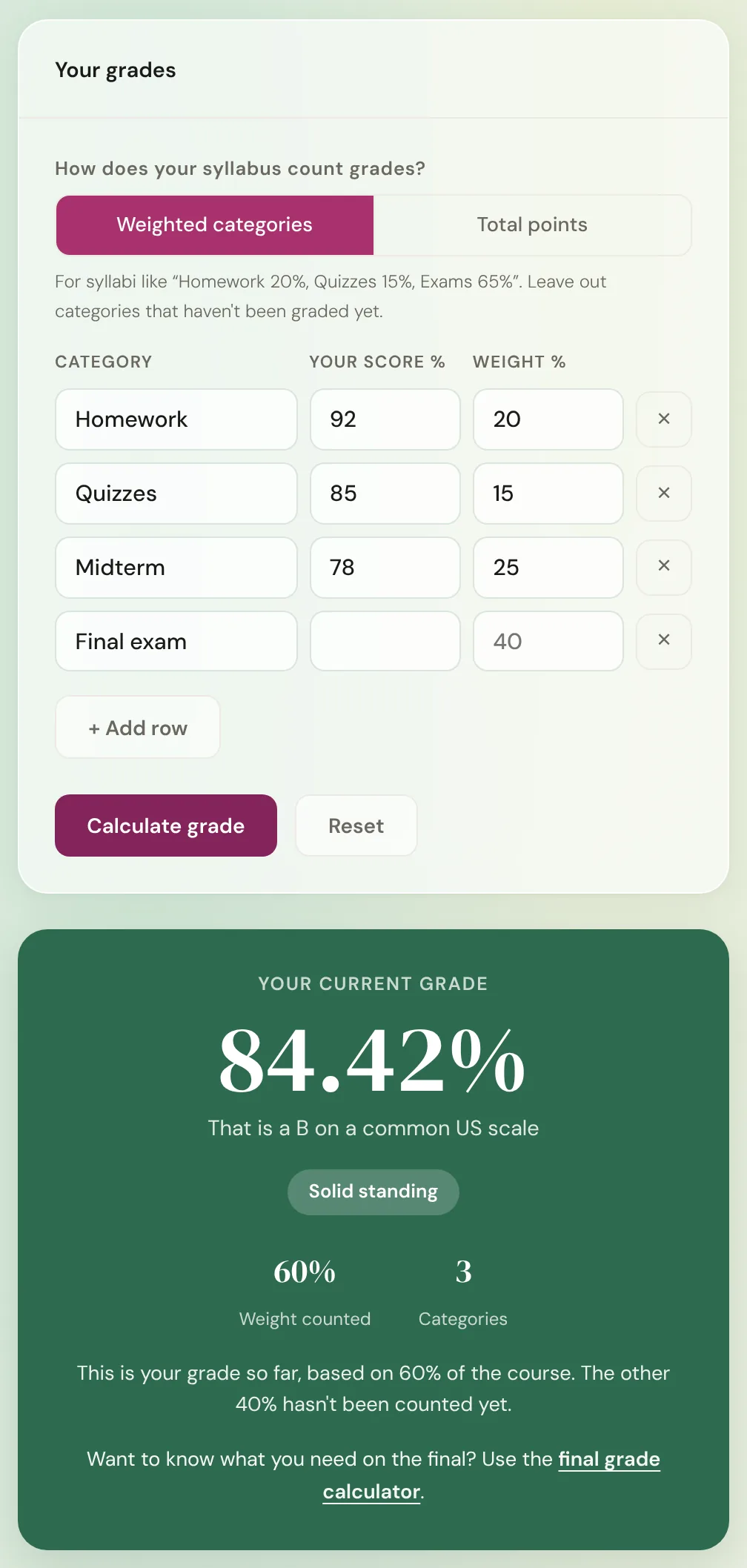
If the weights you enter add up to more than 100%, the calculator scales the result to that total and tells you to check your syllabus. A mistyped weight is the most common reason for a result that looks wrong. The calculator runs in your browser and doesn't store anything you type.
Some classes don't use categories at all. Every assignment is worth a number of points, and your grade is the points you've earned divided by the points possible. A 100-point essay then counts five times as much as a 20-point quiz, without any percentages in the syllabus.
For these classes, switch the calculator to Total points and enter each assignment's points earned and points possible. For example, 86 out of 100, 18 out of 20 and 72 out of 80 add up to 176 out of 200, which is 88%: a B+.
If your result differs from what your school's online gradebook shows, one of these is usually the reason:
If the two still disagree by more than a point or two, ask your teacher which weights and settings the gradebook uses. It's a normal question, and the answer tells you exactly which assignments matter most.
Once you know your grade so far, you can work out what the rest of the course needs to be. In the example, the final is worth 40%. To finish the course with at least 83% (a B), you need (83 − 84.42 × 0.6) ÷ 0.4, or about 80.9% on the final.
The final grade calculator does that math for you, and our guide to what you need on your final walks through more examples, including what to do when the answer is over 100%.
Multiply each category's average by its weight, add the results, and divide by the total weight of the categories graded so far. For example, 92% homework (20%), 85% quizzes (15%) and 78% on the midterm (25%) give 5,065 ÷ 60 = 84.42%.
If some categories haven't been graded yet, divide by the weights you have: the result is your grade so far. If they add up to more than 100%, check the syllabus. The Grade Calculator scales the result to the total and warns you.
No. A weighted grade combines the categories within one class. A weighted GPA averages your final grades across classes and gives extra points for Honors, AP or IB courses.
Usually because of missing work counted as zero, dropped scores, extra credit or rounding. Ask your teacher which weights and settings the gradebook uses.